


We spoke to Simon Carey, Principal at St. David’s Holy Faith Secondary School, about commissioning an artwork through the Per Cent for Art Scheme — and what he learned along the way.
Public art has the ability to shape how a space feels and how it’s experienced day to day. Through the Per Cent for Art Scheme, schools, hospitals and public bodies have the opportunity to commission work that becomes part of that environment.
For those approaching the scheme for the first time, the process can feel unfamiliar. To make it more accessible, we spoke to Simon Carey about his experience commissioning a major installation for St David’s Holy Faith Secondary School in Greystones, Co. Wicklow — from early decisions through to final installation.
The school
St David’s Holy Faith Secondary School sits on a 2.76-acre site and serves nearly 800 students. In 2020, the school began a significant redevelopment project, following plans first set out in 2012. The work included the refurbishment of two existing buildings, the removal of a connecting structure, and the addition of a new four-storey building linking the site together. Alongside this came a new sports arena, gym and astroturf courtyard.
We wanted something bold, modern and reflective of Irish artistry.
“Our students and staff now have a state-of-the-art facility,” Simon says. “It’s a beautiful space, both architecturally and in how it’s used day to day.” This modern, light-filled space set the tone for the new artwork that would adorn it. Simon and his team were adamant that the art installation had to reflect the beauty and functionality of the school’s new design. “We wanted something bold, modern and reflective of Irish artistry,” Simon explains.
The brief and location
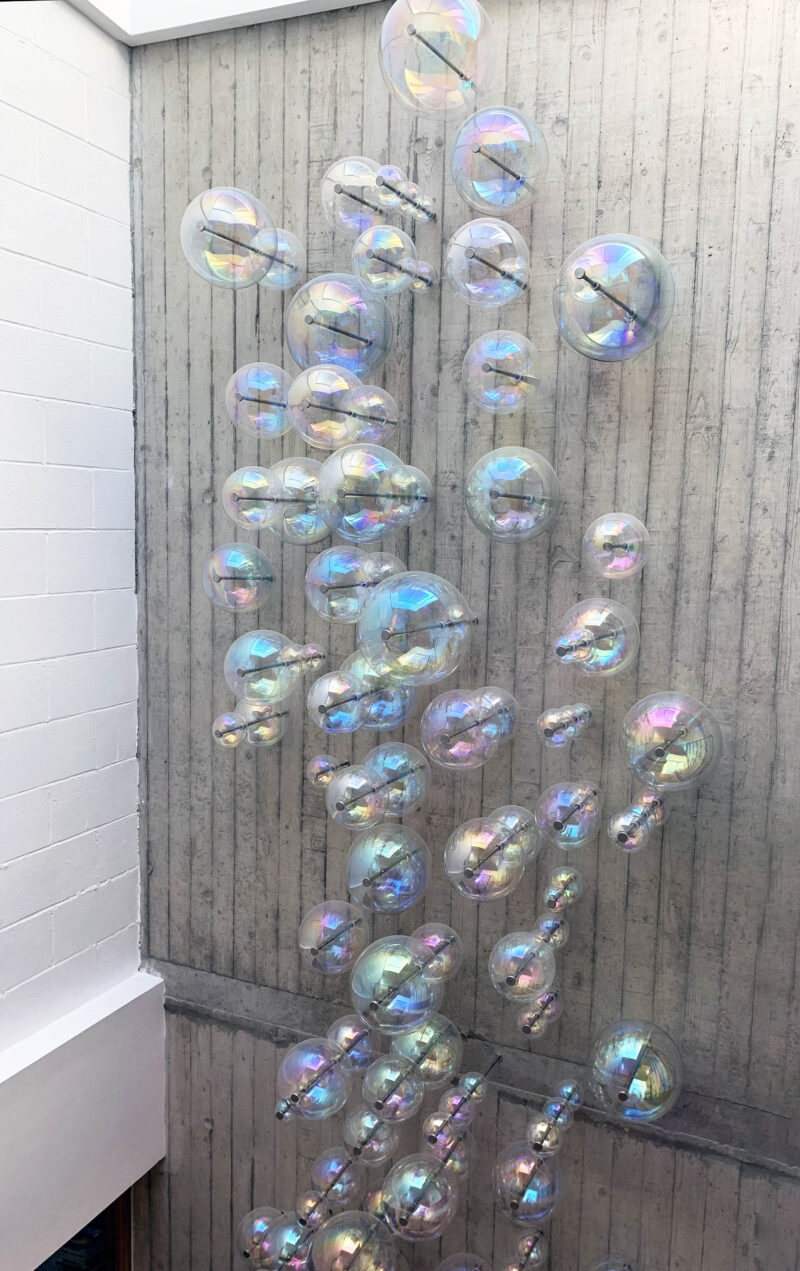
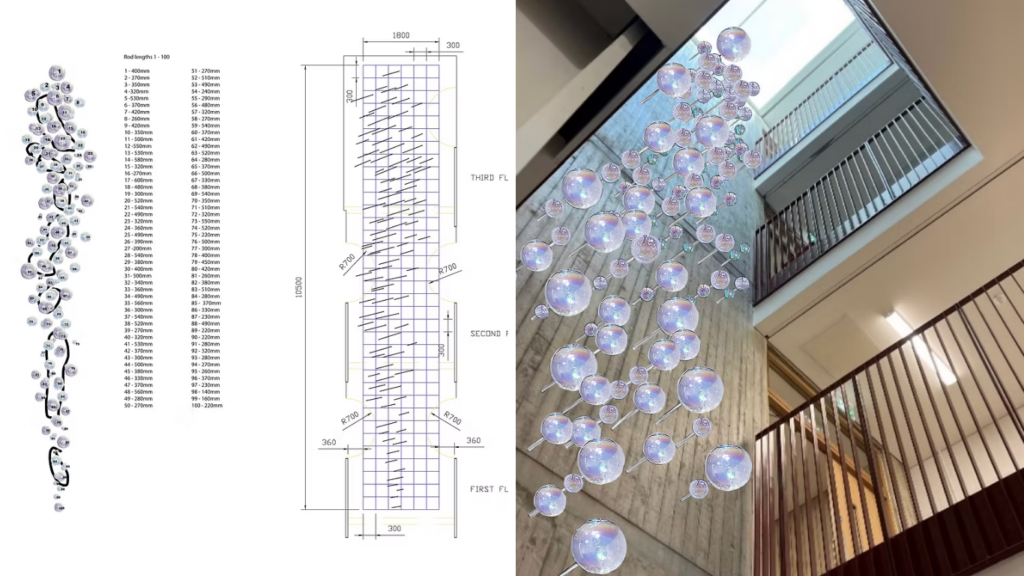
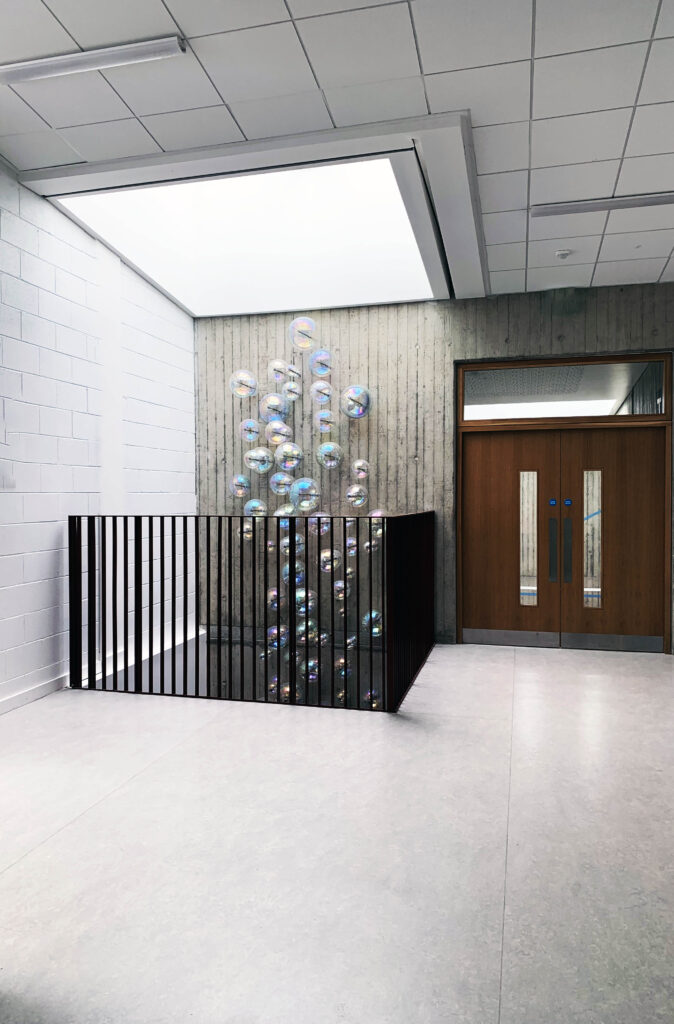
With a clear vision in mind, the team identified a central location: a vertical, shaft-like wall running the full height of the four-storey building alongside the main staircase. “It’s exposed concrete, so it needed something that would respond to that — not compete with it, but work with it,” Simon explains.
The school then contacted the Department of Education to confirm the funding available through the scheme.
“They outlined what we were entitled to — in our case, €51,000,” Simon says. “It’s worth understanding early on how the percentage is calculated, as it’s not always a full 1% of the overall project cost. Having that clarity from the start helps you shape a brief that’s realistic and focused.”
With the budget defined, the school developed a clear brief and advertised the commission through PublicArt.ie and Glassmaking Ireland. “We wanted the art to be linked with Ireland, the sea, and our Holy Faith tradition,” Simon notes. “We were very clear that it should be a bold, modern piece of Irish art.”
Selection of the artist
The open call received 24 applications, which were shortlisted to five.
“We invited each of them to visit the school, to see the space and understand the context,” Simon says. “They then had four weeks to develop their proposals.”
Each submission was reviewed individually before the group came together to discuss. “That part of the process was really valuable — taking time to sit with each proposal and then compare perspectives.”
In the end, Alva Gallagher’s proposal stood out for every team member as the right choice. “Her design was simple, yet striking — a beautiful statement of modernity,” Simon explains. “It had the elegance and boldness we were looking for, and it was a perfect fit for our vision.”
‘Ascend’ — a modern masterpiece
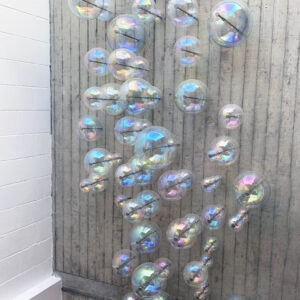
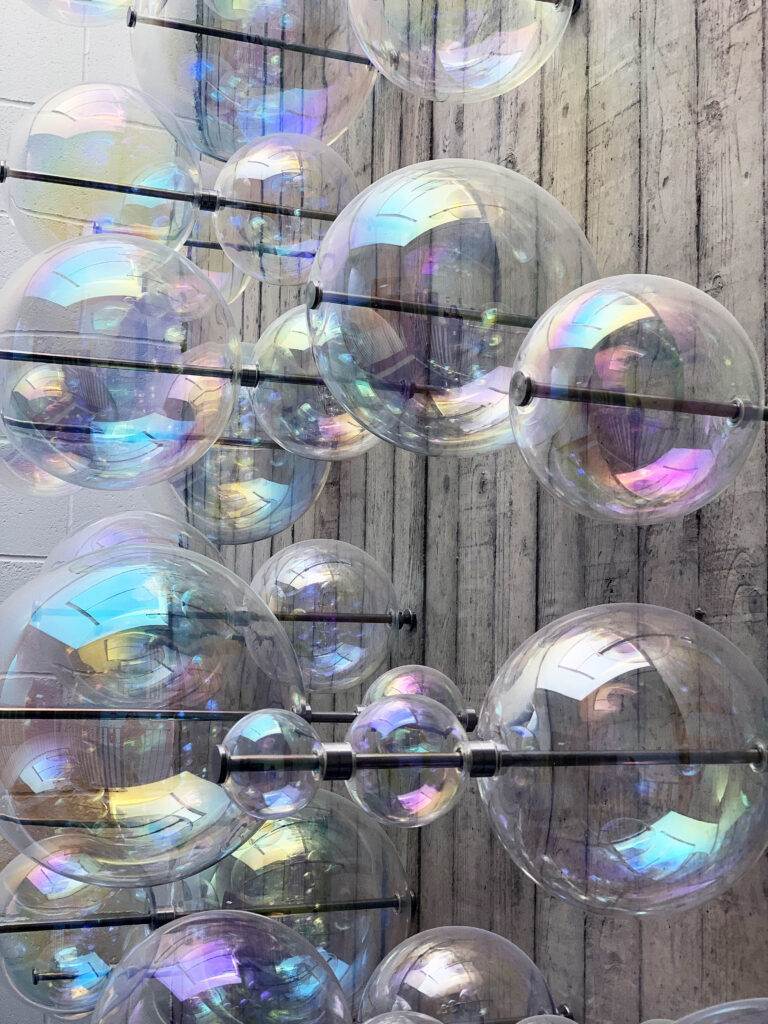
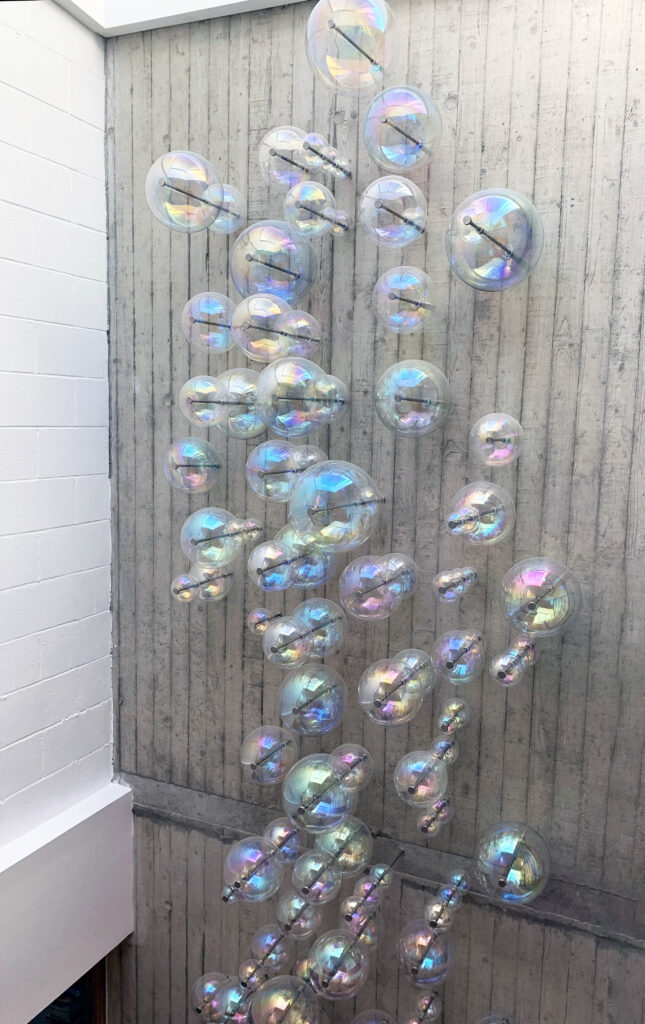
The final piece commissioned by St David’s, Ascend, is a striking installation that spans a total height of 12 meters. It’s a blend of blown glass and stainless steel, designed to reflect the delicate connection between the body and atmosphere, capturing the essence of breath in its suspended form. As Simon explains, “The design had to be something that wasn’t just modern but deeply connected to our space, to Ireland, and to our heritage.”
Ascend features a series of glass orbs in different sizes and shades, connected by steel rods. Depending on the time of day, natural light interacts with the glass, creating shifting patterns and reflections. “What’s special about it is how it evolves with the light,” Simon says. “It’s not static; it changes throughout the day. The students, teachers, and visitors see it differently based on the time and the natural light.”
The 6th-year students, in particular, could technically reach out to the glass orbs at the top, symbolising their transition to adulthood…
The artist behind the piece, Alva Gallagher, captures the essence of breath — that fleeting, yet vital human experience — in her intricate work. It embodies the transitory motion of breath, frozen in time and suspended permanently as a testament to human existence. According to Arttyco Contemporary [@arttyco], Ascend stands as a rising vision of our precious breath, intertwined with the fabric of place and time. It is a permanent and graceful symbol of connection and existence, woven into the very walls of the school.
The orbs symbolically represent the stages of growth and learning, with students, particularly those in their final year, feeling a special connection to the piece. “The 6th-year students, in particular, could technically reach out to the glass orbs at the top, symbolising their transition to adulthood, but they are always completely respectful,” Simon says. The piece, though modern and minimalist, is emotionally resonant and has made a lasting impression on the entire school community.
The PTA, parents, grandparents, and past pupils have all expressed their admiration for the installation. “They see the new architecture and the art together, and it’s a powerful statement,” Simon reflects.
Working with the artist
Once Alva was selected, the collaborative process began. “Alva is partially based in Canada and Ireland, and her team is in Louth. We had about 10 Zoom calls to discuss the project and review samples of the glass orbs that she sent in advance… they were amazing,” Simon recalls. The team visited the school multiple times to ensure they understood the space and measurements before finalizing the design.
By August 2023, the installation process began. “Alva and her team were in the school for four full days. By Wednesday evening, it was all finished and away we went,” Simon says. The smooth collaboration ensured that the artwork was installed on time and to the school’s exact specifications.
What i wish I’d known
While the creative process was fulfilling, Simon faced some challenges with the administration of the scheme. He notes that a simple document designed to guide applicants through the process would be useful to schools. “As principals, we don’t necessarily need all the background detail — what’s most helpful is understanding, in simple terms, what we’re entitled to and how to get started,” he says.
Simon emphasises that a short, practical guide outlining key steps, contacts and examples would make the scheme more accessible for schools approaching it for the first time. “Principals are so busy, and it’s hard to navigate a complicated process without this clarity. After all, if the process is complicated, you might end up settling for second or third best. We were lucky that we knew exactly what we wanted. But other principals might not have the same awareness. That’s where clear, concise guidance could make a big difference.”
The role of the Department of Education
Margaret Brennan, Senior Architect at the Department of Education, offers insights into how the scheme works. “The percentage amount is based on the original cost estimate for the construction of the new build or extension. The school usually procures the art piece after the contractor has left the site,” she explains.
“It’s a small tendering process, and the school can write its own brief. The school often enjoys this part of the process,” she adds. “The school gets great enjoyment from this process and chooses an art piece that reflects their new school.”
Margaret explains that schools have the flexibility to choose how the artwork fits into their vision: “They can choose to make it a permanent art piece or something less tangible, to reflect the process or community.”
She also highlights the importance of timing in the commissioning process: “I think the timing of the project, just after the construction of the new building, is great, as they are all very happy to be free of the disruption.” The final installation of the artwork serves as the culmination of the construction journey, providing a lasting statement that complements the new space.
To help streamline the process, Margaret suggests involving a small group within the school to manage the tender. “I suggest that a small group in the school is formed to run the tender and they get a third party to help them decide on the winning commission.”
Advice for schools
For Simon, clarity of vision is key. “Take time to think about what you want the piece to do,” he says. “It’s a rare opportunity, and it’s worth approaching it with confidence.” He also emphasises the importance of the working relationship with the artist. “Regular communication makes a big difference — site visits, conversations, reviewing materials together.” Practical considerations matter too. “Once the contract is in place, it’s important that payment schedules are followed,” he adds. “It keeps the process running smoothly for everyone involved.”
Conclusion
Simon’s experience with the Per Cent for Arts Scheme shows that the process doesn’t have to be difficult. With clear guidance, determination, and a creative vision, schools, hospitals, and other public bodies can commission beautiful, lasting works of art that reflect their identity and values. The opportunity to bring art into your space is one that can transform not just the building but the community within it. “It’s an amazing opportunity,” Simon says, “and with the right support, it can be incredibly rewarding.”
Tips for commissioning art under the Per Cent for Arts Scheme:
Be clear on your brief: A well-defined idea will guide the entire process
Understand your budget early: Know what’s available and shape your ambition accordingly
Take time with selection: Reviewing proposals carefully leads to stronger outcomes
Work collaboratively: Ongoing dialogue with the artist improves the final result
Keep the process manageable: A small, focused team can oversee the project effectively
Learn from others: Looking at past commissions can help shape your approach