


Title of artwork: The Table
Artist: Ned Jackson Smyth
Year: 2006
Commissioner: Mayo County Council
Funder: Per Cent for Arts Scheme
Per Cent for Arts Location: St. Mary’s Augustinian Friary, Ballyhaunis
A table is a place of gathering, conversation, and shared experience. In The Table, artist Ned Jackson Smyth uses stone, bronze, and earth to create a sculptural installation that invites contemplation, interaction, and reflection. Set within the historic grounds of St. Mary’s Augustinian Friary in Ballyhaunis, this large-scale public artwork draws inspiration from the area’s deep-rooted history and evolving landscape.
Commissioned under the Per Cent for Arts Scheme, The Table is more than a sculpture—it is a dynamic space within the environment, responding to the elements, the passage of time, and the presence of those who encounter it.
Inspiration
Ballyhaunis is a town shaped by layers of history, from its megalithic monuments to its medieval friary and strong agricultural traditions. Located near the Mayo-Roscommon border, it has long been a place of movement, trade, and gathering.
St. Mary’s Augustinian Friary, founded in 1419, sits at the heart of this landscape. Built on the site of a Norman manor house and fortifications, the friary has been a spiritual centre for centuries. The history of the site is marked by resilience—linked to figures such as Fr. Fulgentius Jordan, a Cromwellian martyr; Fr. Myles Prendergast, a patriot of the 1798 rebellion; and Friar Cassidy, an 18th century poet.
With this rich context in mind, The Table was designed as both a physical and symbolic meeting point; it honours the Christian traditions of the site while drawing upon broader philosophical influences. The polished stone surface evokes the idea of gathering, while the unpolished carved forms suggest openness, impermanence, and change.
Process
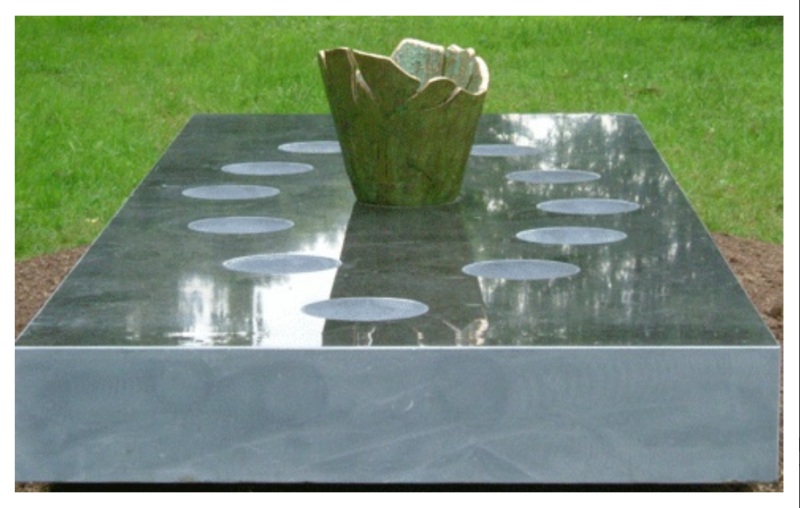
The Table is composed of a highly polished limestone slab, measuring three metres by 1.5 metres, set upon a grassed earthwork mound. Thirteen unpolished curved forms are carved into the stone, with the central dish featuring an inserted bronze element.
The interplay between materials is central to the work’s concept. The polished limestone reflects its surroundings, mirroring the sky and shifting light. The unpolished indentations hold water when it rains, allowing nature to shape the sculpture’s appearance across the seasons. In autumn, fallen leaves collect in the carved hollows, creating organic patterns. In winter, ice forms within the indentations, introducing another dimension of texture and transformation.
Rather than being static, The Table responds to the elements and invites engagement. The work is a meditative space, blending references to Christian ritual with Zen philosophy’s appreciation of nature and imperfection. The unpolished dishes symbolise the unfinished and the evolving—open to time, weather, and interpretation.
Collaboration
As a public art commission, The Table was designed with an awareness of its site-specific context. Its placement within the historic grounds of St. Mary’s Augustinian Friary ensures that it remains part of the landscape’s ongoing story. The work resonates with multiple audiences:
- As a spiritual reference, it echoes themes of communion and gathering.
- As a natural intervention, it invites interaction with the elements—rain, wind, and light shaping its form over time.
- As a sculptural landmark, it provides a contemplative space for visitors, residents, and those connected to the friary’s history.
Through the Per Cent for Arts Scheme, the commission also reflects the value of integrating contemporary art into Ireland’s historical and rural landscapes—bridging past and present, faith and philosophy, nature and sculpture.
About the artist
Ned Jackson Smyth is an Irish sculptor known for his site-responsive works that integrate natural materials, landscape, and cultural history. His practice explores the relationship between human intervention and environmental forces, using materials like limestone, bronze, and earth to create artworks that evolve over time.
His work often draws from ancient and spiritual traditions, engaging with themes of ritual, memory, and transformation. The Table is a continuation of this approach, blending history, faith, and nature into a singular, reflective space.
Legacy
The Table is an enduring presence within the landscape of Ballyhaunis—both as a work of public art and as a space for quiet contemplation. It reflects the town’s layered history while remaining open to new interactions, its meaning shaped by those who visit, the passage of time, and the ever-changing environment.
As a Per Cent for Art commission, The Table demonstrates how public art can enhance historic sites, create moments of reflection, and invite ongoing engagement. By responding to the landscape and the natural world, it ensures that the conversation between past and present, permanence and impermanence, continues.